#2: introducing my shelf, and a personal request to letterboxd to make your api public
Published: 29 Jul 2026
Tags: APIs, Python
← Back to home
Published: 29 Jul 2026
Tags: APIs, Python
← Back to homeI recently added something to my portfolio I'm super excited about: a "Shelf" tab which showcases the latest movies, books, and music I'm getting into.
I think what excites me the most about this little part of my portfolio is that it feels like a small slice of "me" - who I am on a daily basis, what I get up to when I'm not deep in the coding grind. It feels human, which I think in tech we need a little bit more of!
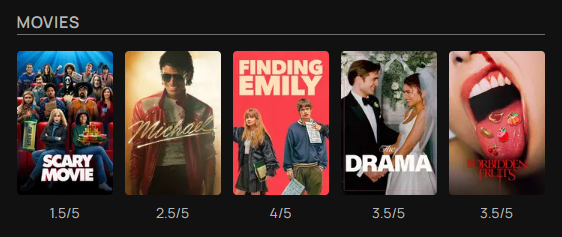
The first section of my shelf is home to my five most recently watched movies, along with the rating I gave them on Letterboxd.
Now, my setup for this particular part of my shelf is a little weird: basically, we're
using Letterboxdpy, a Python library for
scraping Letterboxd, to grab my profile data. Grabbing my diary allows me to get a bunch of
my most recently watched movies and my ratings for them, and I cap this at five.
Then, I grab each movie's information in order to access the movie poster, its name, and
year. This all lives in a script file called fetch_letterboxd.py.
I then take all of this information, bundle it up, and write it to a JSON file.
Then I have a function getLetterboxdData in a TypeScript file which reads the
JSON and renders the data you see above.
Then I have a GitHub Action set up to run every day that runs fetch_letterboxd.py
and pushes the new JSON file to my repo.
Does this feel like more moving parts than I'd like? Yes. Do I want a GitHub Action to be pushing to my portfolio repo every day? No.
So this is a formal and very personal and very nice request to Letterboxd to please make your API public so I don't have to use Python web scrapers 🙏.
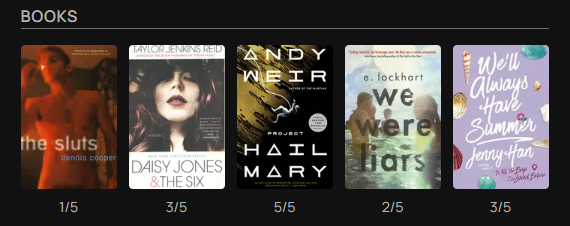
Speaking of companies that do not have a public-use API, the second section of my shelf is home to my most recently read books and my ratings for them!
This data is grabbed from my Goodreads profile. I was incredibly, insurmountably disappointed to learn that the Goodreads public API was shut down several years ago.
This forced me to look for an alternative, much like what I had to do in the case of grabbing my Letterboxd data, but I was much more fortunate this time to find the Goodreads Bookshelf API, a Node.js package that allows me to grab my latest Goodreads data with a simple fetch.
No need for writing or reading any files! A super painless, easy implementation. We love you Goodreads Bookshelf API :)
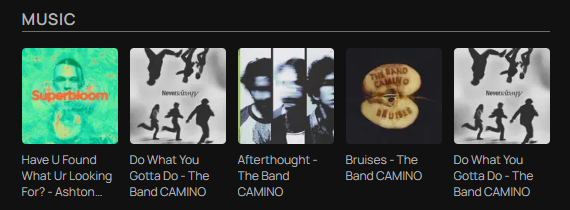
Last but not least, we also have a section for the last five songs I listened to on Spotify.
This required me to interact with the Spotify Web API which is a little more involved than what I did for the previous two sections.
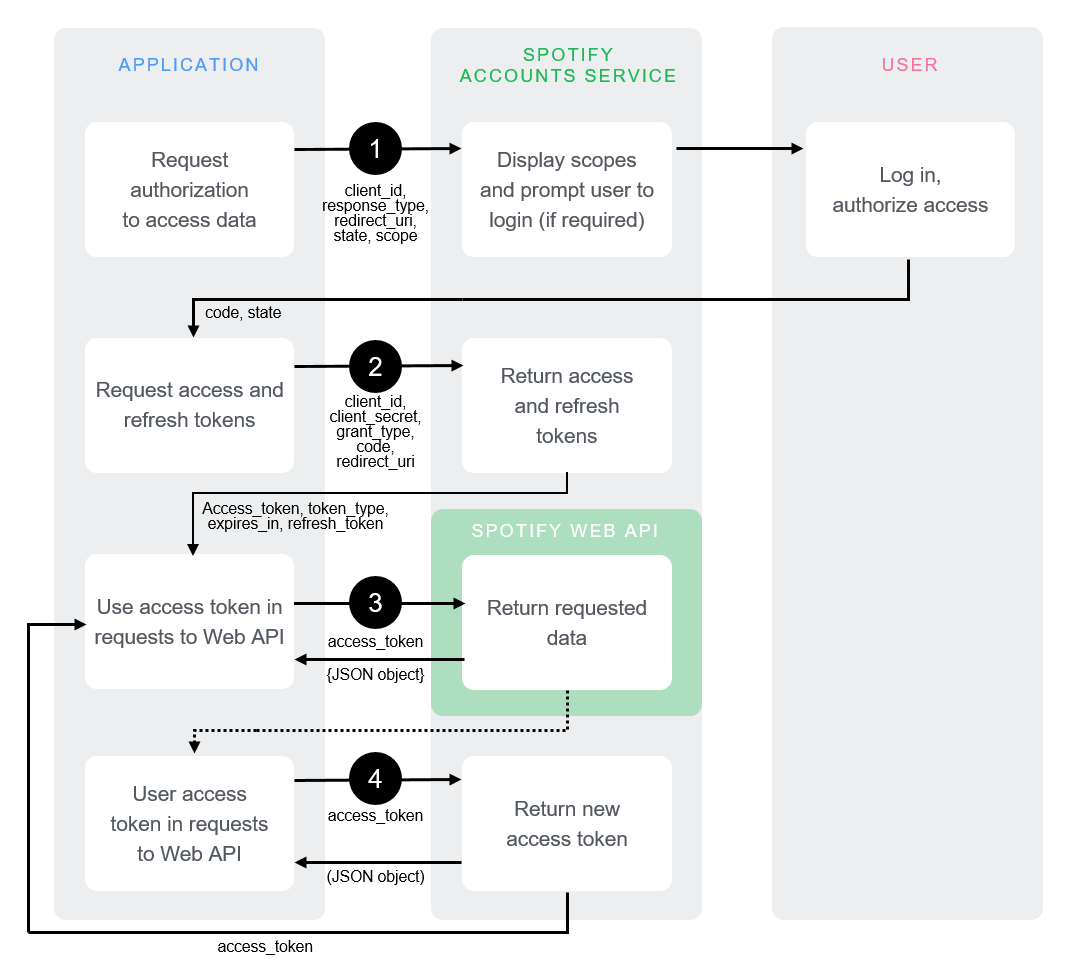
Basically, I had to go through Spotify's OAuth flow once. After creating a Spotify Developer app, I had to perform a one-time login to get a refresh token. Then, I stored that refresh token as an environment variable. This token would later be exchanged for an access token that I could use to hit the "recently played tracks" endpoint.
Lastly, since I'm using APIs, scrapers, and what have you, as well as wanting to keep this shelf as up-to-date as possible, I had to think about how often I wanted to grab data - because I wasn't about to have new fetches every single time we view the shelf.
For my movies, the "cache" is basically the JSON file that lives in my repo. The GitHub Action I've set up to write to that file runs daily, and only commits the new JSON file if anything on it has changed. So every time we navigate to my shelf we're essentially just reading the one JSON file over and over again.
Then, for book and music data, we opt for Next.js caching. We use what's called "Cache
Components"; basically, at the top of my fetch functions, I add "use cache" to tell
Next.js to remember the function's result. Then, I use cacheLife({ revalidate: X }) to
tell it to reuse that result for X seconds before fetching again.
For Spotify, I set the revalidate value to 15 minutes; for Goodreads, it's set to 24 hours.
And that's all there is to it! All in all, a pretty simple implementation but still a fun few hours dedicated to building what's now one of my favorite parts of my portfolio.
Hope you like it as much as I do!
Irene